 | |||||||||
|
“@garycally: Day 1: give the on demand: Day 2: give them back, with the check list and have them set goals. @tarantoannie #tcrwp” love this!
Then I tried it myself. I wrote. I picked a small moment from when I traveled to Chicago.      | |||||||||
Monday, August 10, 2015
Using Checklist with On-Demand
I saw this on TWITTER:


Thursday, July 9, 2015
July TCRWP Reading Institute - Nonfiction Book Clubs with Emily Smith session notes
I was in Emily Smith's Advance Reading Session at the July Reading Institute!!
The topic was Nonfiction Book Clubs, specifically the skills of Synthesis, Comparison and Perspective. Each day, Emily modeled for us through a read-aloud using this book:
 Then I was in a book club with 2 others, reading about Earthquakes. My book was:
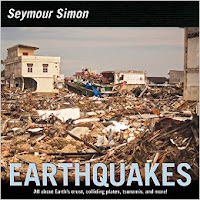
A very useful tool she modeled during the read-aloud with us was using a Vocabulary Word Bank . It looked like this:
 "Turn and tell your club members the meaning of any of the words you know."
She did a shared reading of one part of the book and asked us to tell our group which are the POP OUT SENTENCE or MAIN IDEA SENTENCE and which seems more DETAIL SENTENCES. As she read, she got us to think about what weather is and if all our book club books are related to weather (the other club topics were tornado, hurricane, and volcanoes). Soon our club figured out together that weather only happens in the air so earthquakes are NOT weather.
The last tool she had us try was to listen to a complicated description from the book. Then liten a 2nd time ans SKETCH it. Because I listened and listened again and visualized a sketch, I really got the part of the book about how the sun interacts with the light and moving air to create weather. Here's my sketch that I used to teach my club my idea after hearing the passage read twice:
 Then Emily sent us off to do this kind of work in our book.
What vocabulary words need to be in a bank to help us talk about our book in our club?
What are the Main Idea Sentences and the Detail Sentences?
What text structure is being used to organize the information?
What parts might a sketch help the reader to hold onto the information to then teach it to their club?
Questions to Think About When Planning a NF Read-aloud:
* Think about the skill you want to model (visualize, synthesis, main idea/detail)?
* What tool might help (vocab word bank / a map / a timeline / a ranking system)?
* What is the teaching point and how will you teach (think-aloud, prompt for turn and talks or stop and jots)?
* When will you have kids have a conversation (w/partner, club or whole group)?
Emily introduced us to the Reading Pathway Learning Progressions. She described them as tiny steps within the skills used to read fiction and nonfiction. The 2 sets of skills are divided into:
1. Literal Comprehension (word work, vocab, fluency, and main idea)
2. Interpretive Comprehension (cross text synthesis / compare and contrast)
3. Analytical Comprehension (perspective / growing ideas)
To get a felt sense of the progression, she prompted me to write a summary.

Then I placed it on the SUMMARY PROGRESSION page:
 and my club discussed if it was a 2nd, 3rd, 4th, 5th or 6th grade summary. We decided mine was a 3rd grade summary because it has a main idea with details but does not use the structure of the piece to grasp the info (4th grade work). Emily pointed out that writing about reading can be annotated using the characteristics stated in the progressions. Time can be spent to revise our written comprehension to lift the level of our reading skills.
These Learning Progressions:
* create a vision for what is possible for teaching as the skills are named, grade by grade
* clearly can see what the next steps are in order to raise the level of a reader's comprehension
* clearly can see ALL the many skills that go into this task called reading
Synthesis - to create something new, new understanding, from the parts.
Ask - How do these parts fit together?
Emily suggested that we read with a different lens and then discuss our thinking with our book club.
Just as we read fiction by paying attention to characters, setting and theme, she reminded us that we can read nonfiction with these lenses:
* setting (geography)
* events (cause/effect)
* sequence / timeline
* history
* technology
I chose SEQUENCE/ TIMELINE and reread my Earthquake book, almost skimming to find DATES and I took notes, adding what I read to a timeline. It looks like this:

The topic was Nonfiction Book Clubs, specifically the skills of Synthesis, Comparison and Perspective. Each day, Emily modeled for us through a read-aloud using this book:


A very useful tool she modeled during the read-aloud with us was using a Vocabulary Word Bank . It looked like this:

She did a shared reading of one part of the book and asked us to tell our group which are the POP OUT SENTENCE or MAIN IDEA SENTENCE and which seems more DETAIL SENTENCES. As she read, she got us to think about what weather is and if all our book club books are related to weather (the other club topics were tornado, hurricane, and volcanoes). Soon our club figured out together that weather only happens in the air so earthquakes are NOT weather.
The last tool she had us try was to listen to a complicated description from the book. Then liten a 2nd time ans SKETCH it. Because I listened and listened again and visualized a sketch, I really got the part of the book about how the sun interacts with the light and moving air to create weather. Here's my sketch that I used to teach my club my idea after hearing the passage read twice:

What vocabulary words need to be in a bank to help us talk about our book in our club?
What are the Main Idea Sentences and the Detail Sentences?
What text structure is being used to organize the information?
What parts might a sketch help the reader to hold onto the information to then teach it to their club?
Questions to Think About When Planning a NF Read-aloud:
* Think about the skill you want to model (visualize, synthesis, main idea/detail)?
* What tool might help (vocab word bank / a map / a timeline / a ranking system)?
* What is the teaching point and how will you teach (think-aloud, prompt for turn and talks or stop and jots)?
* When will you have kids have a conversation (w/partner, club or whole group)?
Emily introduced us to the Reading Pathway Learning Progressions. She described them as tiny steps within the skills used to read fiction and nonfiction. The 2 sets of skills are divided into:
1. Literal Comprehension (word work, vocab, fluency, and main idea)
2. Interpretive Comprehension (cross text synthesis / compare and contrast)
3. Analytical Comprehension (perspective / growing ideas)
To get a felt sense of the progression, she prompted me to write a summary.

Then I placed it on the SUMMARY PROGRESSION page:

These Learning Progressions:
* create a vision for what is possible for teaching as the skills are named, grade by grade
* clearly can see what the next steps are in order to raise the level of a reader's comprehension
* clearly can see ALL the many skills that go into this task called reading
Synthesis - to create something new, new understanding, from the parts.
Ask - How do these parts fit together?
Emily suggested that we read with a different lens and then discuss our thinking with our book club.
Just as we read fiction by paying attention to characters, setting and theme, she reminded us that we can read nonfiction with these lenses:
* setting (geography)
* events (cause/effect)
* sequence / timeline
* history
* technology
I chose SEQUENCE/ TIMELINE and reread my Earthquake book, almost skimming to find DATES and I took notes, adding what I read to a timeline. It looks like this:

I loved having a lens to read with. It kept me actively reading. And when we shared in book club, I had stuff to say and stuff to show. As a group member shared her findings about the history of measuring earthquakes, I could match that info to my info. We discussed info that overlapped and new info found by each. We were very engaged and motivated to keep reading to share with our club!
Compare and Contracts - Emily pointed out that as humans, we are wired to naturally compare/contract. We are always looking for patterns to recognize. We can remind our students that this is a life skill and not just a reading skill. We categorize always. Ever since she said this, I see myself doing this. As I write, I use metaphor, a way to compare! As I read, I use my background knowledge to then compare it to what I am reading. Duh!
Emily suggested teaching this first explicitly with a book that is explicitly set up as a compare/contract (ex - Dogs vs Cats). Then move to more complex texts where it is more implied. Then try it across texts (ex - This text says ____ and this text says ____).
FInally she had the tornado club come talk to us (the earthquake club) and we had a lively discussion about what is the same and different between our topics. She reminded us that this can't happen until each group has gathered enough information. But once they have, this is a powerful way to share about the topics that groups are reading about!
Perspective - Start with articles where explicit opinions are being shared.
Then move to less explicit text.
As we read, ask:
*Who is the source?
* What is the point of view of the source?
* If the author were involved in a debate, which side of the topic would he be on?
* What kind of language does the author use?
I will be honest. I love fiction and almost NEVER freely choose to read nonfiction. After a week in an Earthquake Book Club and trying out ways to read my nonfiction book and discuss it with my club members, I am hooked. I do like nonfiction. Thank you, Emily!! I needed this week to immerse myself in this genre and to reading about my reading of it and to discuss it in a club. Because I did it, I now feel more confident to teach it to my 3rd graders next year!!
Tuesday, July 7, 2015
July 2015 TCRWP Reading Institute - Mary's section: Readers Notebooks
My work in Mary's section revolved around Historical Fiction Book Clubs - I was reading the children's novel, War Horse by Michael Morpurgo. (Others were reading the adult book Massie Dobbs by Jacqueline Winspear or the adult book The Eye in the Door by Pat Barker) The common thread was that all 3 books took place during WWI.
Mary first started by sharing research as to WHY we would want to spend time in a book club.
* A Carnegie Study showed how writing about reading raises the level of retention, comprehension and interpretation.
* Mel Levine's work shows that reading or listening or watching only places info our short term memory. It is when we do something with the info (writing, sketching, acting, talking) that the info joins our long-term memory.
* Pedro Niguere's work on peer culture points out that the peer environment will always win over an academic group so we need to make it cool to be doing school.
* Alfred Tetum's work shows that reading flounders when what is being read doesn't match the readers' lives. Mary pointed through choice and honoring the work of a reader who "reads" a baseball game help to make this match. She also shared that when Tetum worked with TCRWP he commented that he saw "too much strategy and not enough soul". He suggested more WHY and not only the HOW.
*Nell Duke's work shows that HS/College kids were dropping out because they had to read too much where they lacked the background knowledge to understand the reading. Research shows the importance of getting ready for a unit by coming to it with built background knowledge.
Using all this research, MARY said we should IMMERSE OURSELVES IN WWI this week. How could be do it? We brainstormed this list:
Here is our map at the end of Monday's 30 minute work session (made by Kyle from CA, Adrienne from WA, Emily from TN and me from VA).
 On Tuesday, Mary shared some TIPS that she modeled on Monday to help the work groups be successful. "Years ago, I would have all the handouts prepared for you and I would have done all the work." As teachers, always think about Efficiency vs Agency. Act more as a coach/guide instead of handing out a project to be completed.
* provide research time around a text
* suggest possible sources that can help so kids aren't starting in a vacuum
* suggest very easy-to-read resources to build BK so it can be understood. (ex WWI for Kids)
* model how a work group can work together (role play)
Her Tuesday tip was perspective. "Be sure to find ALL perspectives. Can you find primary sources from Germany's POV?" After looking all together at a WWI poetry text set, listening to Jerusalem by William Blake set to music and a trench scene from the movie Gallipoli (a war where 100,000 men died in 10 minutes), we got with our work groups again thinking about PERSPECTIVE and instead of going on to make a new thing, Mary encouraged us to look at the work from yesterday and try to raise the level of that work. HOW?
- Consider adding VISUALS
- begin to see your area (mine was the MAP) as a center that on Thursday the class will come look at to learn from. Do captions would be helpful to a visitor?
- Visit others in the room and consider the connections between each part of the room. Do post-it questions need to be added to help a visitor think?
And we were given 20 more minutes to work in our work groups.
My group laughed that we hadn't include Africa on the map made yesterday as we thought about perspective. So quickly we took it down, added more to the bottom. We also added the names of major battles and towns where the book club books occurred. Another group in the room asked to add their work around the leaders during WWI to be next to our map. Soon, our map looked like this:
 While I was learning about WWI by construction a big map for our "Classroom Reading Notebook", others in the room created these displays for us to learn from and on Thursday, Mary gave us time to walk around the room in our BOOK CLUB group to specifically think about OUR story using the room to give us more background on this period in history.


 More pictures should be found here: http://readingandwritingproject.org/resources/mary
NOW while my group was doing ALL this research on the setting of my book club book, I was in a different group reading War Horse (Eric - a staff developer at TCRWP, Barbara from VA and Jean from Buffalo, NY). On Monday we decided as a book club to read 5 chapters a night and to write about our reading by noticing the setting, the emotions of the characters, and the craft moves of the author. Here are some images of our writing about reading notebook pages (sorry, I need to learn how to turn the images around before posting!):

 On Wednesday, Mary shared LOTS of examples from kids notebooks (can be found HERE ).
Then she gave us 20 minutes in class to make one more page and she
moved around the room, coaching us and reminding us to "add some color"!Here is what my group produced!!
On Wednesday, Mary shared LOTS of examples from kids notebooks (can be found HERE ).
Then she gave us 20 minutes in class to make one more page and she
moved around the room, coaching us and reminding us to "add some color"!Here is what my group produced!!


I found it fascinating to see how we sketched, jotted, organized our thinking, all so differently. Knowing that I was responsible for sharing my thinking each day with my group, pushed me to READ and then to really THINK about the story. Each day I was excited to meet as I have new ideas I was pondering and couldn't wait to see what my smart group members were also thinking. PLUS, I really got my story more, because now my "classroom" helped me to find WHERE the story was occurring and the timeline helped me to understand when and the images and word wall helped me to understand concepts. WOW - what brilliant work!!
I asked Mary how young she'd do this kind of work with as I'll be teaching 3rd grade next year. She smiled in her always encouraging way and said she saw 3rd graders in one school do a Native American book club unit! Look out, 3rd graders!!!
One more brilliant thing Mary did with us was a Read-aloud of two picture books set during WWII.

 She read the beginning of each book and asked us to notice the trouble being presented by the author.
She read a little bit more of each book, one after the other, having us notice who is telling the story and how that character responds to trouble. She read more of each pushing us to think about theme. Suddenly, we, the listeners, realized that these books overlap...the girl in Rose Blanche seems to be the Angle Girl! Only Mary would find a way to weave two read-alouds together at once to have us do powerful listening and talking and thinking about characters, settings, themes and craft moves.
Mary modeled three ways to practice with kids:
1. Book to Book - we looked at the role of the woman (the mom) in the book Piggybook by Anthony Brown and the role of the girls in the video Maddie and Tae - Girl in the Country (which is just FUNNY to watch!) music video
My turn-and-talk partner could successfully discuss the role of the mom in the book and then transfer to a video and continue to do the work around these complicated characters.
2. One Reading Experience to Another Reading Experience
Mary showed a video of a baseball play and asked us to read the "text", transferring our school work to outside school work. (Look for article by Mary and Cornelius Minor in Journal of Ed Research coming out soon on this work of connecting the "reading of sports" to reading texts.)
3. Teaching for the transfer of a mindset by teaching toward the values related to reading we most want to instill. To show this, she shared this Kindle - Joy of Reading VIDEO
I feel so spoiled having Mary as a small group instructor and hearing her keynote!!
Next I will share about Emily and Nonfiction Book Club work...tomorrow!
Mary first started by sharing research as to WHY we would want to spend time in a book club.
* A Carnegie Study showed how writing about reading raises the level of retention, comprehension and interpretation.
* Mel Levine's work shows that reading or listening or watching only places info our short term memory. It is when we do something with the info (writing, sketching, acting, talking) that the info joins our long-term memory.
* Pedro Niguere's work on peer culture points out that the peer environment will always win over an academic group so we need to make it cool to be doing school.
* Alfred Tetum's work shows that reading flounders when what is being read doesn't match the readers' lives. Mary pointed through choice and honoring the work of a reader who "reads" a baseball game help to make this match. She also shared that when Tetum worked with TCRWP he commented that he saw "too much strategy and not enough soul". He suggested more WHY and not only the HOW.
*Nell Duke's work shows that HS/College kids were dropping out because they had to read too much where they lacked the background knowledge to understand the reading. Research shows the importance of getting ready for a unit by coming to it with built background knowledge.
Using all this research, MARY said we should IMMERSE OURSELVES IN WWI this week. How could be do it? We brainstormed this list:
- a big map of Europe focused on France
- a big timeline
- vocabulary word wall
- photos from the time period
- movie clips
- primary source documents
Here is our map at the end of Monday's 30 minute work session (made by Kyle from CA, Adrienne from WA, Emily from TN and me from VA).

* provide research time around a text
* suggest possible sources that can help so kids aren't starting in a vacuum
* suggest very easy-to-read resources to build BK so it can be understood. (ex WWI for Kids)
* model how a work group can work together (role play)
My favorite quote: "Role play kids into the academic identities you want to achieve."
Her Tuesday tip was perspective. "Be sure to find ALL perspectives. Can you find primary sources from Germany's POV?" After looking all together at a WWI poetry text set, listening to Jerusalem by William Blake set to music and a trench scene from the movie Gallipoli (a war where 100,000 men died in 10 minutes), we got with our work groups again thinking about PERSPECTIVE and instead of going on to make a new thing, Mary encouraged us to look at the work from yesterday and try to raise the level of that work. HOW?
- Consider adding VISUALS
- begin to see your area (mine was the MAP) as a center that on Thursday the class will come look at to learn from. Do captions would be helpful to a visitor?
- Visit others in the room and consider the connections between each part of the room. Do post-it questions need to be added to help a visitor think?
And we were given 20 more minutes to work in our work groups.
My group laughed that we hadn't include Africa on the map made yesterday as we thought about perspective. So quickly we took it down, added more to the bottom. We also added the names of major battles and towns where the book club books occurred. Another group in the room asked to add their work around the leaders during WWI to be next to our map. Soon, our map looked like this:


 |
| AWESOME TIMELINE!!!! |


 |
| The tasks helped my group really LOOK at the words in relation to our book, War Horse. |


NOW while my group was doing ALL this research on the setting of my book club book, I was in a different group reading War Horse (Eric - a staff developer at TCRWP, Barbara from VA and Jean from Buffalo, NY). On Monday we decided as a book club to read 5 chapters a night and to write about our reading by noticing the setting, the emotions of the characters, and the craft moves of the author. Here are some images of our writing about reading notebook pages (sorry, I need to learn how to turn the images around before posting!):


I found it fascinating to see how we sketched, jotted, organized our thinking, all so differently. Knowing that I was responsible for sharing my thinking each day with my group, pushed me to READ and then to really THINK about the story. Each day I was excited to meet as I have new ideas I was pondering and couldn't wait to see what my smart group members were also thinking. PLUS, I really got my story more, because now my "classroom" helped me to find WHERE the story was occurring and the timeline helped me to understand when and the images and word wall helped me to understand concepts. WOW - what brilliant work!!
I asked Mary how young she'd do this kind of work with as I'll be teaching 3rd grade next year. She smiled in her always encouraging way and said she saw 3rd graders in one school do a Native American book club unit! Look out, 3rd graders!!!
One more brilliant thing Mary did with us was a Read-aloud of two picture books set during WWII.


She read a little bit more of each book, one after the other, having us notice who is telling the story and how that character responds to trouble. She read more of each pushing us to think about theme. Suddenly, we, the listeners, realized that these books overlap...the girl in Rose Blanche seems to be the Angle Girl! Only Mary would find a way to weave two read-alouds together at once to have us do powerful listening and talking and thinking about characters, settings, themes and craft moves.
MARY'S KEYNOTE (on Tuesday) - Remembering Grant Wiggins
The education world lost Grant Wiggins who died last month. He is best known for inventing backwards planning and authored Understanding by Design. First Mary reminded us to make sure we are doing work that we love, like Grant who died so young at age 64. Grant pushed us to think of the child we want to have and then build backwards from there. Grant's latest and sadly last work dealt with the idea of transfer of skills. Grant reminded us that kids need LOTS of practice or scrimmages to try, mess up, get coaching feedback to grow their skills.Mary modeled three ways to practice with kids:
1. Book to Book - we looked at the role of the woman (the mom) in the book Piggybook by Anthony Brown and the role of the girls in the video Maddie and Tae - Girl in the Country (which is just FUNNY to watch!) music video
My turn-and-talk partner could successfully discuss the role of the mom in the book and then transfer to a video and continue to do the work around these complicated characters.
2. One Reading Experience to Another Reading Experience
Mary showed a video of a baseball play and asked us to read the "text", transferring our school work to outside school work. (Look for article by Mary and Cornelius Minor in Journal of Ed Research coming out soon on this work of connecting the "reading of sports" to reading texts.)
3. Teaching for the transfer of a mindset by teaching toward the values related to reading we most want to instill. To show this, she shared this Kindle - Joy of Reading VIDEO
I feel so spoiled having Mary as a small group instructor and hearing her keynote!!
Next I will share about Emily and Nonfiction Book Club work...tomorrow!
Sunday, July 5, 2015
July 2015 Reading Institute - Day 1 - Lucy's Keynote Address
Lucy's Keynote Address - amazing!!! Simply amazing!
I realized that this was my "lucky" 13th Institute as I have been coming to Institutes at TCRWP since the summer of 2007. Lucy starts her keynote the same way, every time I've heard her speak..."You come from..." and names the places around the globe and the positions we hold and the situations we come from. This year she reported that we were from 40 countries and 42 states. A total of 1,300 people chosen from 8,216 applications. I felt so lucky to be sitting in Riverside church to listen and begin a week of work and inspiration.
She spoke of the ideas of Steven Johnson (his TEDtalk is entitled Where do good ideas come from?)
and how his ideas are similar to what happens when our reading students are in book clubs. They are coming together to discuss their book ideas much like Johnson describes as what happens when good ideas are discussed at the Coffee House - an architecture that leads to good ideas. I recommend watching the talk! (And after this week of attending two Advanced Sections that each placed me in a HF and a NF book club, I totally get the value of book clubs and can't wait to run them in my 3rd grade reading workshop during the 2015-16 school year.)
She spoke of the ideas of Brene Brown (her TEDtalk is entitled The power of vulnerability). She stated that we need to be fully engaged and willing to take risks which WILL lead us to feeling vulnerable. However, the alternative is to avoid, disengage, be fearful. She pointed out that in such a state, you are less able to be flexible and responsive. In this state, you are literally stupider! (Another good talk to watch!) She also suggested reading Brene Brown's book: Daring Greatly: How the Courage to be Vulnerable Transforms the Way We Live, Love, Parent and Lead.
To inspire, she had us watch the Collin ES Happy to Read video!! I immediately emailed my school librarian and suggested we make such a video!! It looked fun and as Lucy reminded us, our job is to rally kids to LOVE books and have FUN with books!
She suggested that we must be a public learner, wearing the love of reading on our sleeve!
HOW? A few suggestions include:
* read with your colleagues
* study with your colleagues
* learn from others with the idea that "my school is where the stars come out" and that we all have strengths to offer so lets learn, not just from the noted experts, but from all on staff
* listen
* don't be afraid to bring forth questions
She stated something that really stuck with me the rest of the day...
"Watch kids closely. Embrace the trouble you notice as you watch kids. Get excited to teach them when they struggle." As she said this, I realized that I often do the exact opposite in the classroom. I teach the mini-lesson and then get excited when I watch and see kids doing it right and I get annoyed by the strugglers. But she is right. I should turn my energy around and get excited to reteach through a conference what a struggler struggles with. My lens needs to shift. As she reminded us, we need to be asking "What did you learn today?" and not "What did you teach today?"
Check back as I have much more to share from my Advance Sections:
* Reading Notebooks through Historical Fiction Book Clubs with Mary Ehrenworth
* Nonfiction Book Clubs with Emily Smith
and Keynotes by authors Carmen Agra Deedy, James Howe, Mary Ehrenworth and Kathy Collins
I hope to have all my notes shared by Friday as my week of learning at TCWRP is too great to just keep to myself!
I realized that this was my "lucky" 13th Institute as I have been coming to Institutes at TCRWP since the summer of 2007. Lucy starts her keynote the same way, every time I've heard her speak..."You come from..." and names the places around the globe and the positions we hold and the situations we come from. This year she reported that we were from 40 countries and 42 states. A total of 1,300 people chosen from 8,216 applications. I felt so lucky to be sitting in Riverside church to listen and begin a week of work and inspiration.
She spoke of the ideas of Steven Johnson (his TEDtalk is entitled Where do good ideas come from?)
and how his ideas are similar to what happens when our reading students are in book clubs. They are coming together to discuss their book ideas much like Johnson describes as what happens when good ideas are discussed at the Coffee House - an architecture that leads to good ideas. I recommend watching the talk! (And after this week of attending two Advanced Sections that each placed me in a HF and a NF book club, I totally get the value of book clubs and can't wait to run them in my 3rd grade reading workshop during the 2015-16 school year.)
She spoke of the ideas of Brene Brown (her TEDtalk is entitled The power of vulnerability). She stated that we need to be fully engaged and willing to take risks which WILL lead us to feeling vulnerable. However, the alternative is to avoid, disengage, be fearful. She pointed out that in such a state, you are less able to be flexible and responsive. In this state, you are literally stupider! (Another good talk to watch!) She also suggested reading Brene Brown's book: Daring Greatly: How the Courage to be Vulnerable Transforms the Way We Live, Love, Parent and Lead.
To inspire, she had us watch the Collin ES Happy to Read video!! I immediately emailed my school librarian and suggested we make such a video!! It looked fun and as Lucy reminded us, our job is to rally kids to LOVE books and have FUN with books!
She suggested that we must be a public learner, wearing the love of reading on our sleeve!
HOW? A few suggestions include:
* read with your colleagues
* study with your colleagues
* learn from others with the idea that "my school is where the stars come out" and that we all have strengths to offer so lets learn, not just from the noted experts, but from all on staff
* listen
* don't be afraid to bring forth questions
She stated something that really stuck with me the rest of the day...
"Watch kids closely. Embrace the trouble you notice as you watch kids. Get excited to teach them when they struggle." As she said this, I realized that I often do the exact opposite in the classroom. I teach the mini-lesson and then get excited when I watch and see kids doing it right and I get annoyed by the strugglers. But she is right. I should turn my energy around and get excited to reteach through a conference what a struggler struggles with. My lens needs to shift. As she reminded us, we need to be asking "What did you learn today?" and not "What did you teach today?"
Check back as I have much more to share from my Advance Sections:
* Reading Notebooks through Historical Fiction Book Clubs with Mary Ehrenworth
* Nonfiction Book Clubs with Emily Smith
and Keynotes by authors Carmen Agra Deedy, James Howe, Mary Ehrenworth and Kathy Collins
I hope to have all my notes shared by Friday as my week of learning at TCWRP is too great to just keep to myself!
Wednesday, June 24, 2015
A Handful of Stars - my notes in preparation for a book club discussion

But I was motivated to try such work after reading a blog posting by a friend I follow on twitter (and who I just had the honor of meeting in person Saturday), Julianne - her blog post
She is attending the Teachers College Reading and Writing Project's Writing Institute and her blog made me think that with summer starting, I need to get back into reading like I want my students to read and not just reading quickly for the plot. Julianne also suggested that we have a virtual book club around this book as a few of us bought the book while together last Saturday. I am not sure HOW to have a virtual book club but I told her I was in and now I have read the book and made 33 post-it notes....
As I read, I stopped a few times to do a little research to understand what was happening and to help make a clearer movie in my mind.
One of the characters is Salma and her family is visiting Maine as migrant workers from Florida who use a blueberry rake to harvest the blueberries. A rake?? I couldn't picture it so I went to google images:


Google also helped me in the beginning when the narrator, Lily, spoke with Pepere and Memere and Memere suggested that Lily give a tourtiere to Salma as a thank you. I quickly discovered these are all French words and since Maine, the setting of this story, is so close to Quebec, a French-speaking country in Canada, I better understood the background of the characters.
Pepere = grandpa
Memere = grandma
tourtiere = meat pie.
I tell people that I don't read much nonfiction...yet, I realize now that I was reading nonfiction through my google searches to better understand my fiction story. Good for me!!
As Julianne suggests in her blog, my next step now is to look back through my notes and look for patterns, questions and theories.
I do see patterns emerging around the characters - Salma and Lily, the grandparents, the vet, and Lily's friend, Hannah. I think I could grow a theory about these characters, how and why they change.
I jotted a question before even starting the book, as I looked at the cover - A Handful of Stars? What does that have to do with a dog that can balance a blueberry on his nose? Now that I've finished the book, I think I could write a long answer to my first question.
On page 4, I wrote - Why do they need each other? Salma, Lucky (dog) and the narrator (Lily).
Again, now that I have finished, I think I could answer this.
On page 5 it says, "I don't usually talk to those kids and they don't usually talk to me." I think I could build a theory around the idea of diversity and mixing with different kinds of people.
Once I finished the book I jotted that this is a beautiful story about friendship and overcoming loneliness and overcoming differences. I think I could say/write more about this.
I think I have things to say about this book....however, I know I need to do much more thinking.
I need to sort my post-its and really think about the characters and the changes they go through. And then I need to ask, what is the author really trying to teach me through this book.
Confession: This is hard work and I plan to think about it more tomorrow....
To learn more about the author, Cynthia Lord, check out her WEBSITE.
I have read ALL of her novels and I loved them ALL, including this latest book!
Monday, April 6, 2015
My Notes from attending the 88th Annual TCRWP March Saturday Reunion
1. Kathy Collins suggested a way to know more about a reader
is to look at a reader's SHELFIE - a photo of the stack of books they
recently have read. What can we infer about this reader? Who in the room
do you think matches THIS "Shelfie" photo? This reminds me of tweeting
out this picture of my kindle of what I read over Winter Break:
2. Lucy has me wanting to teach READING again (presently, I teach 5th grade writing). The grade-level specific Reading Units of Study come out in a few months (click HERE foor info
) and she gave a workshop overview of them. She reminded us that both
reading and writing need to be taught differently now in the 21st
century. Then she challenged us: What are the pathways of my teaching to
get students to read in this new way? She suggested in her hour
workshop doing three things:
* Kids need to be assessed in reading using a running record and the data needs to be used and valued. It can be an informal RR - as they read their own book, listen and note their rate and miscues and then tell the reader what level of book to read.
* Running Records aren't enough. Performance assessments (developed and included in the new Reading Units of Study!) based on a progression of reading skills need to be used. This provides a clear pathway for a reader to know what they are able to do and what needs to be done. How to get better at a skill is named and known because the progressions name the skill, grade by grade so a skill can be deliberately practiced!
3. Kylene Beers
- this was my first first hearing this funny, smart voice of literacy. A
Texan, she was appropriately wearing very cool red cowboy boots! I was
able to get a seat for her first workshop on Fiction. As I was leaving,
the line to get in was 3x as big as the room. All wanted to hear about
her new book coming out - Notes and Notices for reading Nonfiction which
she talked about in the next session.
In this session, she walked us through the Six Signposts to look for when reading fiction. I honestly have not taught using this language but I own her book and have skimmed it. Hearing her, it makes perfect sense to me as to why it works. As Ellin Keene got readers to notice what THEY were doing as they read (connecting, questioning, inferring, etc), Kylene tells us to notice what is happening to the CHARACTER and to pay close attention when the character acts out of character or has an ah-ha moment. Notice when another character asks a tough question of the character. Notice when something keeps appearing or is repeated again and again. When these moments are noticed, the reader is sure to get what the author is really saying through this book. Kylene's strategies build on how I thought about reading comprehension and I need to actually READ her whole book and get her new Nonfiction book coming out soon.
She also had us read a poem called Forgive My Guilt by Robert Tristram Coffin (read it here)
With a partner, we were to fill in the chart Somebody-Wanted-But-So for the narrator and for the birds. Then she asked for volunteers to share sentences written. She asked us: Was the hunting deliberate? Accidental? What is the text evidence? She had us notice words we didn't immediately know, like frostflower, headland, plover, and quicksilver. This summary lesson still has me thinking about this poem! And such a simple strategy - using SWBS chart!
4. Shana Frazin - Help Students Love Rehearsal, Revision and Checklists: Tap the Power of Merging Joy with Assessment. She joked that the real title is Turning the Titanic! She walked us through an inquiry lesson on What is Revision? After stating what we know, she told us to look at some writing and to notice: 1) what revision work did the writer make? 2) how did the revision affect us, the audience? 3) as educators, what was the teaching that happened between the two pieces of writing
Here's two of the before/after writing pieces she shared:
.JPG)
.JPG) The
last part of the inquiry asked us to complete this sentence: I used to
think that revision was ___ and now I think revision is ____.
The
last part of the inquiry asked us to complete this sentence: I used to
think that revision was ___ and now I think revision is ____.
A gem that she shared at the end was a way to help the checklists work better for student writers.
She reminded us of the brilliance of the writing checklists - the same 3 categories (structure, development and conventions) across the three genres (narrative, NF, and essay) and the same skills with in each category. Maybe to help our students, we hang 3 charts up, one for each category. In the first column, we list the skill (the part of their writing, like lead), the middle column, we add the words from the checklist that is the grade-level expectation of this part. Then in the last column, we add an example. We talk about if this example meets the expectation and why.
WOW - Shana - you are SO clear. I'll be tweeting the charts I make and how the Revision Inquiry lesson goes with my 5th graders next week as I'm determined to turn this lesson you taught me around with my students!
.JPG) 5. Mary - Good to Great Pathways and Ladders for Strong Writers so They May Become Extraordinary -
Teaching in a school with lots of great writers, I loved hearing from
Mary ways to help these top students. As she said, often these are the
kids who get the least attention because a teacher's time gets sucked up
by the struggling writers. Yet, these strong writers deserve attention
so they don't just get good but can become brilliant writers.
5. Mary - Good to Great Pathways and Ladders for Strong Writers so They May Become Extraordinary -
Teaching in a school with lots of great writers, I loved hearing from
Mary ways to help these top students. As she said, often these are the
kids who get the least attention because a teacher's time gets sucked up
by the struggling writers. Yet, these strong writers deserve attention
so they don't just get good but can become brilliant writers.
Basics:
* Make sure you actually confer with them
* Pair them up with other STRONG writers
* Suggest meeting with them at extra times or outside of class - give them the encouragement and the opportunity to work hard on this skill that they are strong in
* Offer them tools - the checklist at the next higher grade, a different mentor text, different inquiry questions
Strategy
* Show them how to draft an entirely different draft - use a different style, write it for a different audience, try the 1st paragraph 5 different ways. She reminded us that this is the strategy suggested by Don Murray, Steven King and Mark Twain!
* Do serious and open ended inquiry work with a mentor text.
For example, use technology - she showed us the music video of Wake me Up by Avicii and asked us to think about the work the author is doing with SETTING. How is the setting important?
Click here to watch Wake Me Up Then she played it again, turning off the sound and voicing over a story as the images appear emphasizing the setting. Then she suggested: Now try this SETTING WORK in your writing. Mary - you are so brilliant!!
6. Final Keynote by Kylene Beers
I feel lucky that I got a seat in Riverside church as my one friend stopped to use the bathroom and got closed out and could come in. The nave and both balconies were filled. As I read tweets afterwards, Amanda Hartman tweeted "4,000 people today, wow!" This was my 12th reunion - I've come every Fall and Spring following my first Summer Institute in 2009. It definitely felt more crowded. More and more, teachers want to learn HOW to do literacy work well. And in my opinion (and probably the opinion of the 4,000 around me yesterday), TCRWP is THE place to learn.
Kylene opened by pondering What do I believe about teaching?
.JPG)
.JPG) | ||
| What does this tell you about ME, the reader of these four books? |
* Kids need to be assessed in reading using a running record and the data needs to be used and valued. It can be an informal RR - as they read their own book, listen and note their rate and miscues and then tell the reader what level of book to read.
* Running Records aren't enough. Performance assessments (developed and included in the new Reading Units of Study!) based on a progression of reading skills need to be used. This provides a clear pathway for a reader to know what they are able to do and what needs to be done. How to get better at a skill is named and known because the progressions name the skill, grade by grade so a skill can be deliberately practiced!
"Deliberate practice of a skill makes us better, not just doing a skill."
*Writing
About Reading - we need to show HOW to write about reading in Reading
Workshop. Mentor texts showing how the writing of a post-it needs to be
shared and displayed so when writers stop to jot, they are using this
non-reading time wisely.
In this session, she walked us through the Six Signposts to look for when reading fiction. I honestly have not taught using this language but I own her book and have skimmed it. Hearing her, it makes perfect sense to me as to why it works. As Ellin Keene got readers to notice what THEY were doing as they read (connecting, questioning, inferring, etc), Kylene tells us to notice what is happening to the CHARACTER and to pay close attention when the character acts out of character or has an ah-ha moment. Notice when another character asks a tough question of the character. Notice when something keeps appearing or is repeated again and again. When these moments are noticed, the reader is sure to get what the author is really saying through this book. Kylene's strategies build on how I thought about reading comprehension and I need to actually READ her whole book and get her new Nonfiction book coming out soon.
She also had us read a poem called Forgive My Guilt by Robert Tristram Coffin (read it here)
With a partner, we were to fill in the chart Somebody-Wanted-But-So for the narrator and for the birds. Then she asked for volunteers to share sentences written. She asked us: Was the hunting deliberate? Accidental? What is the text evidence? She had us notice words we didn't immediately know, like frostflower, headland, plover, and quicksilver. This summary lesson still has me thinking about this poem! And such a simple strategy - using SWBS chart!
4. Shana Frazin - Help Students Love Rehearsal, Revision and Checklists: Tap the Power of Merging Joy with Assessment. She joked that the real title is Turning the Titanic! She walked us through an inquiry lesson on What is Revision? After stating what we know, she told us to look at some writing and to notice: 1) what revision work did the writer make? 2) how did the revision affect us, the audience? 3) as educators, what was the teaching that happened between the two pieces of writing
Here's two of the before/after writing pieces she shared:
A gem that she shared at the end was a way to help the checklists work better for student writers.
She reminded us of the brilliance of the writing checklists - the same 3 categories (structure, development and conventions) across the three genres (narrative, NF, and essay) and the same skills with in each category. Maybe to help our students, we hang 3 charts up, one for each category. In the first column, we list the skill (the part of their writing, like lead), the middle column, we add the words from the checklist that is the grade-level expectation of this part. Then in the last column, we add an example. We talk about if this example meets the expectation and why.
WOW - Shana - you are SO clear. I'll be tweeting the charts I make and how the Revision Inquiry lesson goes with my 5th graders next week as I'm determined to turn this lesson you taught me around with my students!
Basics:
* Make sure you actually confer with them
* Pair them up with other STRONG writers
* Suggest meeting with them at extra times or outside of class - give them the encouragement and the opportunity to work hard on this skill that they are strong in
* Offer them tools - the checklist at the next higher grade, a different mentor text, different inquiry questions
Strategy
* Show them how to draft an entirely different draft - use a different style, write it for a different audience, try the 1st paragraph 5 different ways. She reminded us that this is the strategy suggested by Don Murray, Steven King and Mark Twain!
* Do serious and open ended inquiry work with a mentor text.
For example, use technology - she showed us the music video of Wake me Up by Avicii and asked us to think about the work the author is doing with SETTING. How is the setting important?
Click here to watch Wake Me Up Then she played it again, turning off the sound and voicing over a story as the images appear emphasizing the setting. Then she suggested: Now try this SETTING WORK in your writing. Mary - you are so brilliant!!
6. Final Keynote by Kylene Beers
I feel lucky that I got a seat in Riverside church as my one friend stopped to use the bathroom and got closed out and could come in. The nave and both balconies were filled. As I read tweets afterwards, Amanda Hartman tweeted "4,000 people today, wow!" This was my 12th reunion - I've come every Fall and Spring following my first Summer Institute in 2009. It definitely felt more crowded. More and more, teachers want to learn HOW to do literacy work well. And in my opinion (and probably the opinion of the 4,000 around me yesterday), TCRWP is THE place to learn.
Kylene opened by pondering What do I believe about teaching?
"When you change the way you look at things, the things you look at change."
She
then gave a brief overview of the history of education in America. She
pointed out that literacy has always been tied to wealth. First, you
were considered literate if you could sign your name, sometimes just by
making an X. Next, great penmanship was valued (clearly, the poorest
didn't have time to write using beautiful penmanship). Then great
speeches and poetry recitation. During WWI, the assembly line led to
analysis and things like diagraming sentences and cliff notes. But now,
she remarked, instead of taking things apart, we need to put things
together.
We
need education practices to not just be interesting, but to be
relevant. She suggested we need CHOICE, a curriculum based on more than
tests, and that through literature we teach COMPASSION. Only than can
those with power through literacy can use their privilege to learn how
to navigate life well.
7. Meeting Slicers at The Kitchette!! Hi Tara, Catherine and Fran!!
Far right is Fran - see her reunion reflection HERE
Middle is Catherine - see her blog HERE
Far left is Tara - see her blog HERE
So glad I went to the TCRPW 88th Saturday Reunion.
So glad I know it is worthwhile to spend all day learning on a Saturday, miles away from my home.
So
glad I have a place to write about it here to share these great ideas
with others who also believe that teaching literacy well is important.
Saturday, December 20, 2014
Poetry Inspiration
Naomi Shihab Nye!!
Click HERE to hear her recite a poem which is just a collection of things her son said.
She reminds us to LIVE LIKE A POET, always looking and listening for the words because
she reminds us that "we are ALL poets when we are little. Some of us just try to keep up the habit."
Sunday, November 23, 2014
NCTE CONFERENCE - my first but not my last!!
What an amazing weekend! I am fortunate to live in the Washington Metropolitan area so it was very easy to attend the NCTE conference as it was held nearby at the Gaylord at Harbor Place, 20 minutes from my house. My main draw was to go hear Ellin Keene speak on Saturday at 9:30am. I met Ellin when my daughter Bridgit began college. Bridgit became best friends with her hall mate, Elizabeth Keene, on the first day of college at Barnard. Once I met Elizabeth's mom, Ellin, at Parent's Weekend, we became friends, both around being Barnard moms and both around our love of literacy.
So as I drove very early to the Gaylord on Saturday morning, I had ONE brilliant person to see. Who knew the two days would be FILLED with such rich discussion by so many brilliant educators around my favorite topic - strong literacy instruction.
Some of my take-aways (in order of hearing them!):
LUCY CALKINS with Amanda and Alex: After hearing Lucy's description of what is involved on a conference, I realize I need to work on my conferences. I know the architecture of a conference but I am NOT doing it. Lucy reminded me of the WHY of conferring and the HOW of conferring. Now I just need to NOT just plan the daily mini-lesson but to also plan my daily/weekly conferences!
ELLIN with Linda Hoyt and Seymore Simon:
Ellin pondered why curious kinders seem to lose their natural curiosity as they continue in school. She questioned who is in charge of the engagement? She had us think of a time when we were so engaged and motivated to learn. She reminded us that this feeling is what we want for our students. She suggested that when the following is present, we are engaged, will stay curious and are motivated to learn:
* intellectual urgency - we have a topic we MUST know about
*emotional commitment - we have a topic we care about and want our heart, as well as, our mind to know more about it
* perspective bending - we have a topic that changes our mind
* aesthetics - we have a topic where we can find a deep sense of beauty
Both Ellin and Linda Hoyt suggested reading this book:

So as I drove very early to the Gaylord on Saturday morning, I had ONE brilliant person to see. Who knew the two days would be FILLED with such rich discussion by so many brilliant educators around my favorite topic - strong literacy instruction.
Some of my take-aways (in order of hearing them!):
LUCY CALKINS with Amanda and Alex: After hearing Lucy's description of what is involved on a conference, I realize I need to work on my conferences. I know the architecture of a conference but I am NOT doing it. Lucy reminded me of the WHY of conferring and the HOW of conferring. Now I just need to NOT just plan the daily mini-lesson but to also plan my daily/weekly conferences!
ELLIN with Linda Hoyt and Seymore Simon:
Ellin pondered why curious kinders seem to lose their natural curiosity as they continue in school. She questioned who is in charge of the engagement? She had us think of a time when we were so engaged and motivated to learn. She reminded us that this feeling is what we want for our students. She suggested that when the following is present, we are engaged, will stay curious and are motivated to learn:
* intellectual urgency - we have a topic we MUST know about
*emotional commitment - we have a topic we care about and want our heart, as well as, our mind to know more about it
* perspective bending - we have a topic that changes our mind
* aesthetics - we have a topic where we can find a deep sense of beauty
Both Ellin and Linda Hoyt suggested reading this book:
so I did and then I went to hear him speak. He presented with a HS teacher who suggested that the oldest way of reading was the reading of animal tracks. She showed us a photo she took that looked like raccoon tracks in the snow. She simply asked us: WHAT DO YOU SEE HERE? and WHAT IS IT TELLING YOU? She shared how it is these 2 simple questions that guides her students to find patterns, motifs, images, and surprising details so they can comprehend any reading passage.
MARY EHRENHERT, Vicki Vinton and Katherine Boomer
Mary is the master of having her audience "read" videos. She had us watch three different New York City Public Service Announcements. She told us to come to this text with the understanding that it is about more than one thing. We need to read nonfiction closely. We need to talk back to it. We need to not be victims of nonfiction but actively analyze it, aware that a hidden agenda could be present. Mary reminded us that we don't teach kids how to read nonfiction to pass a test. We teach them how to read nonfiction for the lives they will live.
KRISTI and MARGORIE with Zoe - Chartchum ladies!!
Kristi is an amazing presenter! I will admit that I thought of charts as the cute thing to make. Kristi presented it as a way to organize information for thinkers who solve problems. So when a problem arises in a classroom, a routine chart can be created to solve the problem. To help kids be flexible and realize they can try many ways to solve a problem, a repertoire chart can be co-constructred. Now the flexible thinker can see his choices. Thinkers also need to be strategic, so step-by-step charts can be made. Thinkers also look to mentors and models for examples so exemplar charts are made. I get it NOW!! Charts are NOT just information. Charts are thinking. Charts give us the tools to overcome. Charts are tools to make us feel independent and powerful!! (Personally, I need to work on how I use charts. So glad I could be reminded by the chartchum ladies today!!)
RALPH FLETCHER skyping with two teachers
WOW!! What a great last session!! A teacher in Alaska and a teacher in Boston used kidblog to match each kid up with a student in the others class. Both classes were reading aloud Fig Pudding by Ralph Fletcher. Then one class created questions around chapters 1-4 of the book and the other around chapters 5-8. The students were tasked with writing a friendly letter to their partner and respond to the posted questions. The blog posting shared were amazing! One teacher said he reminded the kids that "their words were their face so be sure to represent yourself well in writing." The teachers checked the letters and would not send it until it was following all the expected written conventions of 4th grade. I was amazed at the exchanges around a shared book. Then to skype with Ralph was just icing on the cake!! My daughter is working in a school in France right now. I think I want to try something like this with her school. In preparation, I am going to investigate kidblog and The Bread Loaf Teacher Network, two resources used by these two teachers.
Thank you NCTE for coming to The Gaylord!! I can't promise I'll attend next year in Minnesota (seems far away and cold!) but I WILL attend again and I'm so glad I attended this year!!
Sunday, October 19, 2014
My Take-Aways - TCRWP's 10-18-14 Saturday Reunion
My Take-Aways
from the October 18,
2014 TCRWP Saturday Reunion
Since the next unit of study I’ll
be teaching with my 5th graders is Research-based Argument Essay, I
attended the Keynote by Kelly Boland Hohne, “Debate Can Engine Higher Level
Thinking and Reading.” Then Lucy’s talk, “From Boot Camp to Revision: An
Overview of a Unit on Essay Writing.” Then a talk by Meghan Hargrave,
“Structure, Elaboration, and Analysis are New Ambitions: Raising the Stakes for
Fourth and Fifth Grade Opinion Writers. What a perfect set of talks to get me
fired up and prepared to teach this next unit of study well!
·
Lucy explained the WHY behind the boot camp
model and it makes perfect sense to me to spend two days guiding the class to
write an essay together so they see right from the start the structure of an
essay. I like ________ because of _____, because of ________. And most of all,
because of ________.
·
She explained how to develop each reason by
either telling a small story, writing a list divided into subcategories, or
asking and answering a question.
·
Once the class together has written in the air,
an essay (our topic was I like ice cream), then she said to have the class
flash draft the essay.
·
Now the teacher can read the flash drafts and
see who gets this structure. She suggested looking to see if it is divided into
paragraphs and if each section is a separate paragraph and if each paragraph
has a topic sentence. If not, this can be taught on Day 2. Also on Day 2, she
said an elaboration lesson can be shared using prompts to get the essayists to
write more.
o
Elaboration Prompts – In other words, I realize
that, This is important because, For example, This shows, Some people might
think __ but I think, Therefore, from this day forward…
Lucy also noted that essay writing
can be practiced by having a debate which Kelly Boland Hohne demonstrated so
well during her keynote. She suggested an easy way to get debate going in your
classroom is to embed a few specific prompts into the regular read-aloud. She
shared 2 kinds - prompts to argue about
a text and prompts to argue inside the text. She demonstrated using the picture
book, Fox by Margaret Wild.
Debates we had:
1.
She stopped at the part when Magpie is about to
tell Dog why not to trust Fox and she said, “It seems Dog and Magpie are about
to have an argument. Partner 1, you be Magpie. Partner 2, you be Dog. Now have
that argument. Be the character and talk as the character. Role play it now!
2.
She stopped at the part when Magpie leaves Dog
and goes with Fox. She asked: Who is responsible for Magpie leaving Dog.
Partner 1 – I take the position that Magpie is responsible. Here’s why. Partner
2 – I take the position that Fox is more responsible. Here’s why.
3.
She also suggested that another debate could be
the internal argument that Magpie was having. Partner 1 – I should stay with
dog. Partner 2 – I should really go with fox.
Then Kelly said, “We needed to put this work into kids’
hands because teachers can’t be the keeper of the questions.” We tried this
with the Spring chapter in Frog and Toad!
In her teacher voice she said, “I shouldn’t be the only ones
to ask questions. Today let’s have an inquiry read-aloud. As you listen, think
about WHAT COULD WE DEBATE? A tip is that debates related to a text usually
happen when: the reader has a wondering, the reader notices different emotions,
and when something is upset in the text. As I read, be thinking: WHAT’S THE
QUESTION I REALLY WANT TO ARGUE? Once done, ask for questions and chart them.
Pick one and have the debate. If it is messy and doesn’t go so well, reflect as
a class on that. Why didn’t this question work well? What makes for a good
question? Try it again and again, all year long!!
She gave us a handout of an anchor chart:
WHAT SEEMS WORTH ARGUING ABOUT IN LITERATURE?
·
Is this character strong or weak?
·
Should the character have made that choice or
not?
·
The story teachers us ____ or ____?
·
Which character is more to blame?
·
Did the ___ represent __ or ___?
She ended by saying: Debate is not a thing. Debate is a culture.
It is a way to be critical. We want to encourage kids to ASK, to ARGUE as a way
of being!
Clearly these two talks have me fired up to get my 5th
graders debating and writing argument essays. Then I heard Meghan Hargrave
talk. She described her ideas as the next layer to Lucy’s Boot Camp talk, a way
to take opinion writing to the next level.
She grew Lucy’s boxes and bullets structure :
(Thesis statement) because (reason 1), (reason 2), and most
of all, because (reason 3).
·
One reason that (thesis statement) is that
(reason 1). For example (evidence a), (evidence b) and (evidence c).
·
Another reason that (thesis statement) is that
(reason 2). For example (evidence a), (evidence b) and (evidence c).
·
The most important reason that (thesis
statement) is that (reason 3). For example (evidence a), (evidence b) and
(evidence c).
She suggested, like Lucy, to start the unit off with
explicitly saying, “Here’s how to write an essay. Fill it all in! The teacher
can use it during conferring time to remind kids who are having trouble with
the structure.
She suggested making the structure tactile – use index
cards. Write down the big idea and the bullets. Move them around. Add
transition word cards. Play around with it to get the essay in the order that
works.
She suggested that instead of having a long list of
transition words, group them:
Words that give example -
for example, another, for instance, also, as you can see
Words that connect – also, and, in addition
Words that analyze evidence – this shows, the important
thing is, so
Words that make evidence seem stronger – specifically, more
than, in particular, exactly
She shared how in narrative, writers stretch out the heart
of the story. This same idea can be done by essay writers. She showed an anchor
chart that read: Bring out the heart of the essay. ASK Why does this matter? Why am I choosing to write about
THIS topic? What do I want readers to think, feel, and know?
To Elaborate, she also suggested using prompts to push
writers’ thinking. The prompts are language that gets writers to say more. She
suggested charting the kinds of evidence: mini-story, facts, statistics,
definitions, quote from a source. When a student lacks evidence, ask them to
reread and see WHERE one of these could be added. She also showed how to use
the Gr 6-8 Technique and Goal Picture Cards that were shared with me this
summer and that are in the 6-8 Units of Study for Teaching Writing kits.
Ex) The writer’s goal is to elaborate. What will they do?
They can back up each reason with evidence. HOW? I will include ____ (use the
picture cards). Now a very clear goal is written and pictured for the essay
writer!
Finally she shared some moves to help writers analyze. When
a writer has picked evidence, ask them SO WHAT? And have them talk/write back
to answer it. This talking back is the analysis. How do you know?
What do you mean? What makes this quote/fact/mini-story/etc
so important?
Now I feel more than ready to guide my 5th
graders to write a research-based argument essay!!
I also listen to Mary Ehrenworth speak about ways to teach
grammar.
And Emily Smith speak about goal setting, checklists and
Feedback.
And I got inspired by Carl Anderson’s final keynote.
WHAT an amazing Saturday of learning!
I’m so looking forward to going to work tomorrow and using
all the great ideas I heard as I teach this year.
Subscribe to:
Posts (Atom)